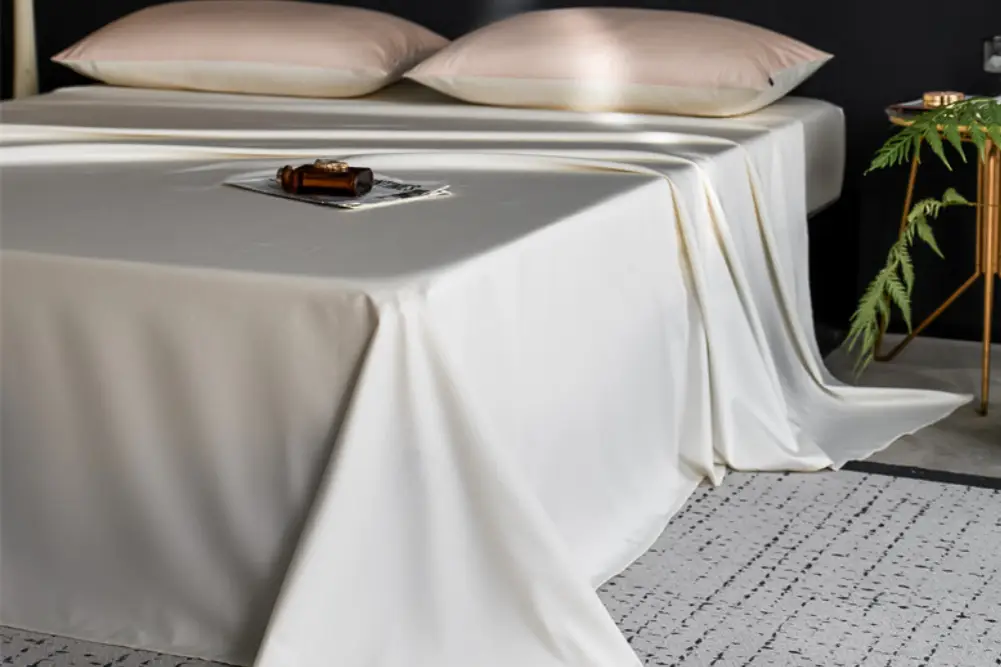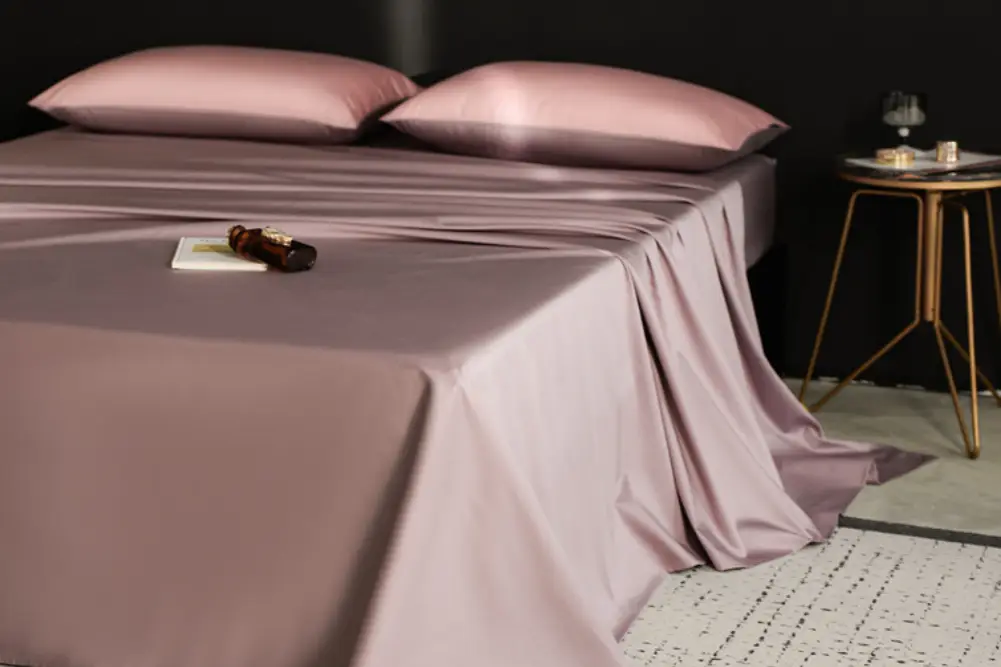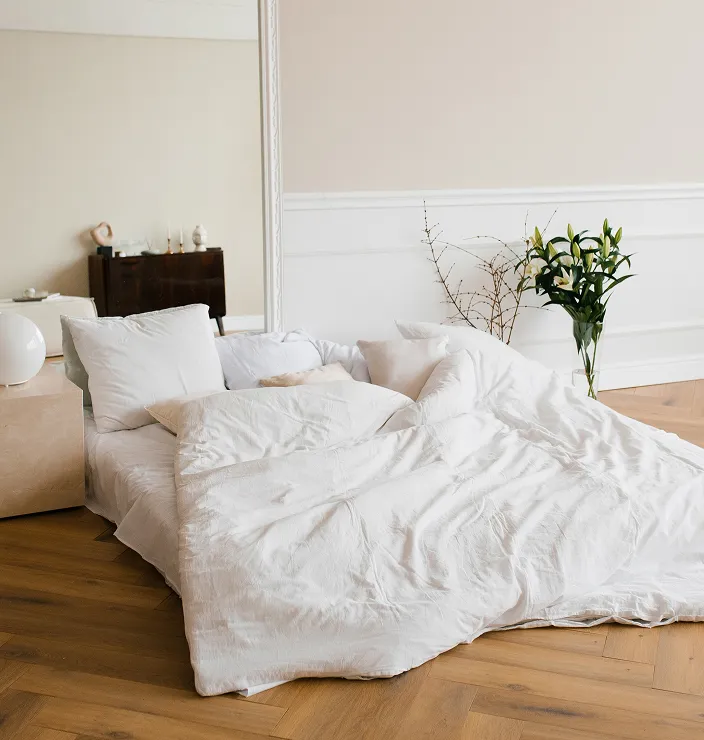
Most people have had this experience: the fitted sheet slips off the mattress corners in the middle of the night. It bunches up, wrinkles form, and a good night’s sleep is ruined. Many shoppers blame the sheet quality, but the real cause is usually much simpler — the sheet’s pocket depth does not match the mattress depth.
Modern mattresses are much thicker than they used to be. Traditional innerspring mattresses were mostly 8–10 inches thick. Today’s hybrid and memory foam mattresses commonly range from 12–16 inches. A standard fitted sheet was not designed for these thicker beds, so it cannot stay in place.
This article covers what deep pocket sheets are, how to measure mattress depth, sizing charts, fabric choices, and tips to keep sheets from slipping. The advice here draws on industry experience from a manufacturer — RUHO Living — that has supplied bedding to globally recognized hotel brands for over 20 years.
What Are Deep Pocket Sheets?
The “pocket” of a fitted sheet is the sewn sidewall at each corner. It extends downward from the sleeping surface to the elastic hem. Pocket depth is the total length of this sidewall, and it determines how thick of a mattress the sheet can wrap around.
A standard fitted sheet typically has a pocket depth of 7–12 inches. This is enough for traditional 8–10 inch innerspring mattresses. When the pocket depth reaches 13 inches or more, the industry generally calls it a deep pocket sheet.
It is important to know that “deep pocket” is not a term with one fixed definition across the industry. Some brands label a 13-inch pocket as a deep pocket, while others start at 15 inches. Shoppers should always check the specific inch measurement on the product label rather than relying only on the “deep pocket” label.
The demand for deep pocket sheets has grown because mattress design has changed a lot over the past 20 years. Traditional innerspring mattresses were typically 8–10 inches thick. Current hybrid mattresses are mostly 11.5–14.5 inches (a spring layer of 6–8 inches plus a comfort layer of 2–4 inches). Memory foam mattresses commonly range from 10–14 inches, and pillow-top designs can add another 2–4 inches.
Many people also add a mattress topper (typically 2–4 inches) on top, which can easily push the total depth beyond 15 inches. Standard fitted sheets simply cannot cover that. This shift in mattress thickness is the main reason why deep pocket sheets have gone from a niche product to an everyday need for many households.
Deep Pocket Sheets vs Regular Sheets: What’s the Difference?
The table below shows how the three main sheet categories compare:
| Sheet Type | Pocket Depth | Fits Mattress Depth | Typical Use Case |
| Standard | 7–12 inches | Up to 10 inches | Traditional innerspring mattresses, daybed mattresses, sofa bed mattresses |
| Deep Pocket | 13–17 inches | 11–15 inches | Hybrid mattresses, memory foam mattresses, mattresses with thin toppers |
| Extra Deep Pocket | 18–22 inches | 16–20+ inches | Pillow-top mattresses with thick toppers, adjustable-base setups, luxury hotel mattresses |
The core dimension that separates these three categories is the pocket depth in inches — not the brand-defined name. When shopping, always check the actual labeled inch value.
Keep in mind that “standard” is not itself a uniform standard. Some brands’ standard is only 7 inches, while others go up to 12 inches. In the same way, “deep pocket” can vary by 2–4 inches between brands. The best approach is to compare the measured mattress depth directly against the pocket depth listed on the product page.
When choosing sheets, the pocket depth should be 2–3 inches more than the actual mattress depth. This extra room allows the elastic hem to wrap and tuck properly. If the pocket is too shallow, the corners will slip off. If it is too deep, extra fabric will bunch up and wrinkle on the mattress surface.
How Deep Are Deep Pocket Sheets?

Building on the three main categories from the previous section, here is a closer look at the sizing tiers.
The industry-standard range for deep pocket sheets is 13–17 inches. Within this range, further differences exist. Sheets with 13–14 inch pockets fit 11–12 inch mattresses — this is sometimes called light deep pocket. Sheets with 15–17 inch pockets fit 13–15 inch mattresses and represent the standard deep pocket range. Most hybrid mattresses on the market today fall into this group.
Extra deep pocket sheets are 18–22 inches. These are designed for ultra-thick mattresses over 16 inches — usually a pillow-top mattress combined with a thick topper. These sheets have more limited supply on the market and tend to be priced slightly higher because they require more fabric to produce.
One common source of confusion deserves special attention: some brands describe their product as “fits mattresses up to X inches” (the compatible mattress thickness), while others list “pocket depth: X inches” (the pocket’s own depth). These two numbers mean different things. Pocket depth is typically 2–3 inches greater than the compatible mattress depth. For example, a sheet labeled “pocket depth: 17 inches” fits a mattress around 14–15 inches thick, not a 17-inch mattress. Mixing up these two numbers is one of the most common mistakes shoppers make when buying sheets online.
How to Measure Mattress Depth for Fitted Sheets
Before buying any fitted sheet, accurately measuring the mattress depth is a necessary first step. Without this measurement, even the most detailed product description will not help a shopper find the right fit. The good news is that the process is quick and easy. The only tools needed are a tape measure or a rigid ruler. No special skills are required. The entire measurement takes about 2 minutes, and the result will guide every sheet purchase going forward.
Step 1 — Remove All Bedding
Take off all sheets, blankets, comforters, and duvets. If a mattress topper is used daily, leave it on — its thickness must be included in the total depth. If a mattress pad is used (thinner, typically no more than 1 inch), leave it on as well. The goal is to match the actual bed surface height under everyday conditions.
Step 2 — Measure from Top to Bottom
Place the tape measure vertically against the side of the mattress. Measure from the very top surface to the very bottom. Two things to keep in mind: first, measure at the middle of the mattress side, not at the corners — corners may have 1–2 inches of compression due to sewing. Second, make sure the tape measure is straight up and down, not angled. An angled measurement will read too high. Write down this number in inches — this is the bare mattress depth.
Step 3 — Include Your Mattress Topper
If a mattress topper is used, lay it flat on the mattress and measure the total height again. Most toppers are 2–4 inches thick (the most common are 2 inches and 3 inches). For example, a 12-inch hybrid mattress plus a 3-inch memory foam topper gives a total depth of 15 inches. This combined number is the true reference point when picking a fitted sheet.
Step 4 — Add 2–3 Inches for Tucking
Add an extra 2–3 inches to the total depth from Step 2 or Step 3. This extra room ensures that the fitted sheet’s elastic hem can fully wrap around to the bottom of the mattress. If the hem barely reaches the bottom with no extra room, the sheet is very likely to pull off during the night. So the formula is: required pocket depth = measured total depth + 2 to 3 inches.
Step 5 — Match Your Measurement to Sheet Pocket Depth
Compare the calculated pocket depth against the three main categories (Standard / Deep Pocket / Extra Deep Pocket) to find the right type. For example, a total depth of 13 inches plus 2 inches of tucking allowance equals at least 15 inches of pocket depth needed — choose the Deep Pocket type. Another example: a total depth of 17 inches plus 3 inches of tucking equals 20 inches of pocket depth needed — choose the Extra Deep Pocket type.
When shopping online, look for products that clearly state the specific pocket depth in inches, rather than products that only say “deep pocket” without giving a number.
What Size Fitted Sheet Do You Need? (Mattress-to-Sheet Match Chart)

The chart below helps shoppers quickly find the right sheet type and pocket depth based on their mattress thickness.
| Mattress Depth | With Topper (est.) | Recommended Sheet Type | Min. Pocket Depth Needed |
| 8 in. or less | 10–11 in. | Standard | 10–12 in. |
| 10 in. | 12–13 in. | Standard or Deep Pocket | 12–14 in. |
| 11 in. | 13–14 in. | Deep Pocket | 14–15 in. |
| 12 in. | 14–15 in. | Deep Pocket | 15–16 in. |
| 13 in. | 15–16 in. | Deep Pocket | 16–17 in. |
| 14 in. | 16–17 in. | Deep Pocket or Extra Deep | 17–18 in. |
| 15 in. | 17–18 in. | Extra Deep Pocket | 18–19 in. |
| 16 in. + | 18–20+ in. | Extra Deep Pocket | 20–22 in. |
The “With Topper” column is based on a 2–3 inch topper. Actual values depend on the specific topper thickness, so readers should rely on their own measurements. The “Min. Pocket Depth Needed” column already includes about 2 inches of tucking allowance.
A 12-inch mattress is a key threshold. A standard sheet (pocket depth up to 12 inches) can barely fit, but with no tucking allowance, it is very likely to slip off at night. For mattresses 12 inches and above, deep pocket sheets are the recommended choice.
Will Deep Pocket Sheets Fit a Regular Mattress?
They can be used, but it is not the best idea.
When deep pocket sheets are placed on a thin mattress, the extra fabric bunches up underneath or at the four corners. This causes the sleeping surface to wrinkle and become uneven, which hurts both comfort and appearance. Bunched fabric can also shift during the night, making the fit even worse over time. In the hotel industry, precise matching between bedding and mattresses is standard practice. Both too-deep and too-shallow sheets are considered unacceptable because they create an untidy look and reduce guest comfort.
The best practice is to pick a sheet with a pocket depth 2–3 inches greater than the measured mattress depth — not too tight and not too loose. For thin mattresses of 8–10 inches, or for beds in RVs and daybeds, standard pocket or even low-profile fitted sheets are the right choice. There is no benefit to buying deep pocket sheets for a mattress that does not need them. Getting the match right is always the better approach.
Best Materials for Deep Pocket Sheets
Pocket depth answers the question of “can it fit on the mattress.” The fabric and weave determine “how comfortable it feels after fitting.” When choosing deep pocket sheets, the fabric’s stretch and recovery are especially important. The deeper the pocket, the more area the fabric needs to cover. If the fabric lacks enough elasticity, it tends to sag at the corners.
100% Cotton: This is the most popular deep pocket sheet fabric. Cotton is breathable, holds up well after many washes, and gets softer over time. The key difference is between long-staple cotton and short-staple cotton. Long-staple cotton has longer fibers, higher strength, and is less likely to pill. This makes it the preferred fabric for hotel-grade bedding. A thread count in the 300–600 range is a good sign of quality. If a product claims a thread count above 800, be cautious — the count may be inflated through multi-ply yarn techniques.
Manufacturers that supply hotel chains — such as RUHO Living, which has produced bed linens for brands including Hilton and Sheraton for over two decades — typically use long-staple cotton in the 300T–1000T range for their fitted sheets, focusing on durability and a smooth feel that improves with laundering.
Microfiber: This is the lowest price option. Microfiber sheets have a smooth feel but are less breathable than cotton. They work well for budget-minded shoppers or for guest rooms and spare bedrooms. Microfiber is less durable than cotton and may pill after many washes.
Bamboo / Bamboo-Derived Rayon: These sheets feel silky and cool to the touch, with some moisture-wicking ability. They suit sleepers who tend to feel hot. However, most “bamboo sheets” on the market are actually bamboo-derived rayon or viscose, which involves chemical processing during production.
Linen: Linen offers excellent airflow and is ideal for hot climates. The texture is rougher than cotton, and linen’s elasticity in deep pocket designs is not as good as cotton or microfiber. It works best for standard-depth mattresses.
How to Keep Deep Pocket Sheets from Slipping
Here are several practical tips to stop fitted sheets from sliding off the mattress.
Choose a fully elasticized hem. Some lower-priced sheets only have elastic at the four corners, with no elastic along the sides. This reduces the wrapping force. A fully elasticized hem — where the elastic runs all the way around — is the standard for hotel-use products and makes a big difference in keeping the sheet in place.
Use sheet suspenders or bed sheet clips. These are cross-shaped or triangular elastic clips that fasten between the sheet corners and the underside of the mattress. They are effective and inexpensive, typically under $15.
Match pocket depth correctly. As covered earlier, both too-deep and too-shallow pockets cause slipping. The pocket depth should be 2–3 inches more than the mattress depth.
Avoid stacking too many layers. Using a mattress pad, a topper, and a protector all at the same time creates multiple layers. The more layers, the more friction directions between them, and the more likely they are to slide against each other.
Check the elastic regularly. After 50–100 washes, the elastic band loses its stretch and holding power. When this happens, it is time to replace the fitted sheet.
FAQs
What Is the Difference Between Deep Pocket and Extra Deep Pocket Sheets?
Deep pocket sheets typically have a pocket depth of 13–17 inches and fit mattresses that are 11–15 inches thick. Extra deep pocket sheets have a pocket depth of 18–22 inches and are designed for ultra-thick mattresses over 16 inches, especially pillow-top and topper combinations. The fabric and construction are the same for both types. The core difference is the length of the sidewall fabric. Shoppers should choose based on their actual measured mattress depth.
Do Deep Pocket Sheets Cost More Than Regular Sheets?
Deep pocket sheets are usually priced slightly higher than standard sheets of the same fabric because they use more material for the longer sidewalls. However, the price difference is typically small — within the same brand, it is usually in the $5–$20 range. The bigger factor in pricing is fabric quality, such as cotton versus microfiber, thread count, and long-staple versus short-staple cotton. It is not worth choosing a sheet with too little pocket depth just to save a few dollars. The discomfort of sheets slipping off every night far outweighs the small price difference.
Conclusion
The key steps are simple: measure the total mattress depth (including any topper), add 2–3 inches for tucking, then match that number against the sizing chart to select the right sheet type. Always look for products that list a specific pocket depth in inches.
Most sheet-slipping problems are not about poor quality. They are about sizing mismatch. Correct measurement is the easiest and most effective fix.
For more information on fitted sheet fabrics and specifications, readers can browse RUHO Living’s product pages for further reference.